
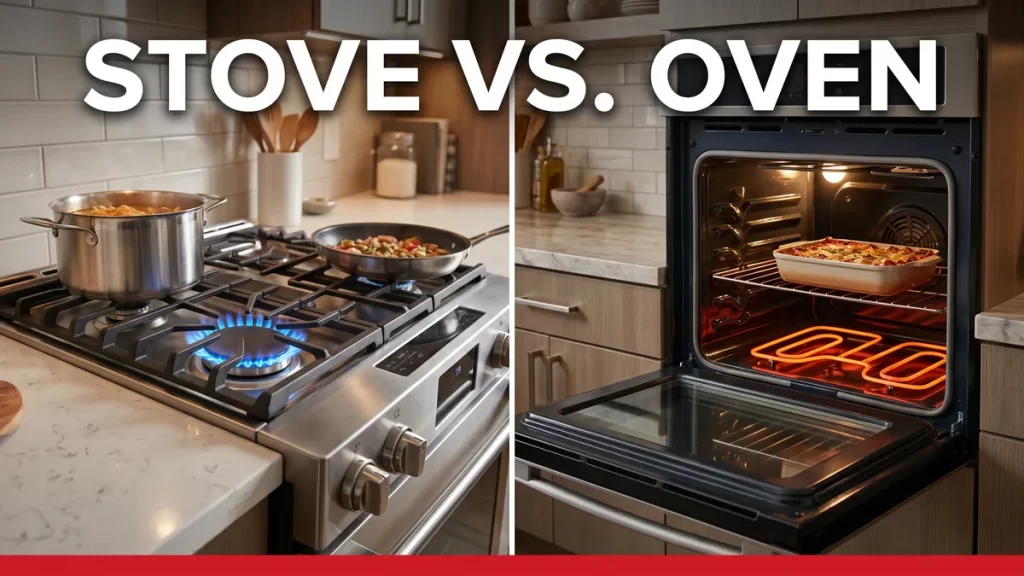
Most people use “stove” and “oven” as if they mean the same thing. They don’t, and the confusion costs money when something breaks. The stove is the cooking surface, the part with the burners. The oven is the enclosed compartment below it (or beside it) where you roast, bake, and broil. When your stove isn’t heating properly or your oven won’t reach temperature in London, Ontario, the repair depends entirely on which part failed.
Here’s how to tell the difference, what typically goes wrong in each, and when a call to a local repair tech is the right call.
The actual difference between a stove and an oven
A stove has burners on top that provide direct heat to your cookware. An oven uses enclosed radiant heat, a bake element (electric models), or a burner (gas models) to cook food from all sides. A “range” combines both in a single appliance: the stove on top, the oven below. A “cooktop” is a standalone cooking surface with no oven attached.
Stove problems vs. oven problems: a side-by-side comparison
| Feature | Stove / Cooktop | Oven |
|---|---|---|
| Location | Top surface of the range | Enclosed chamber below (or separate) |
| Heat method | Direct burner/coil heat to cookware | Radiant/convection heat surrounding food |
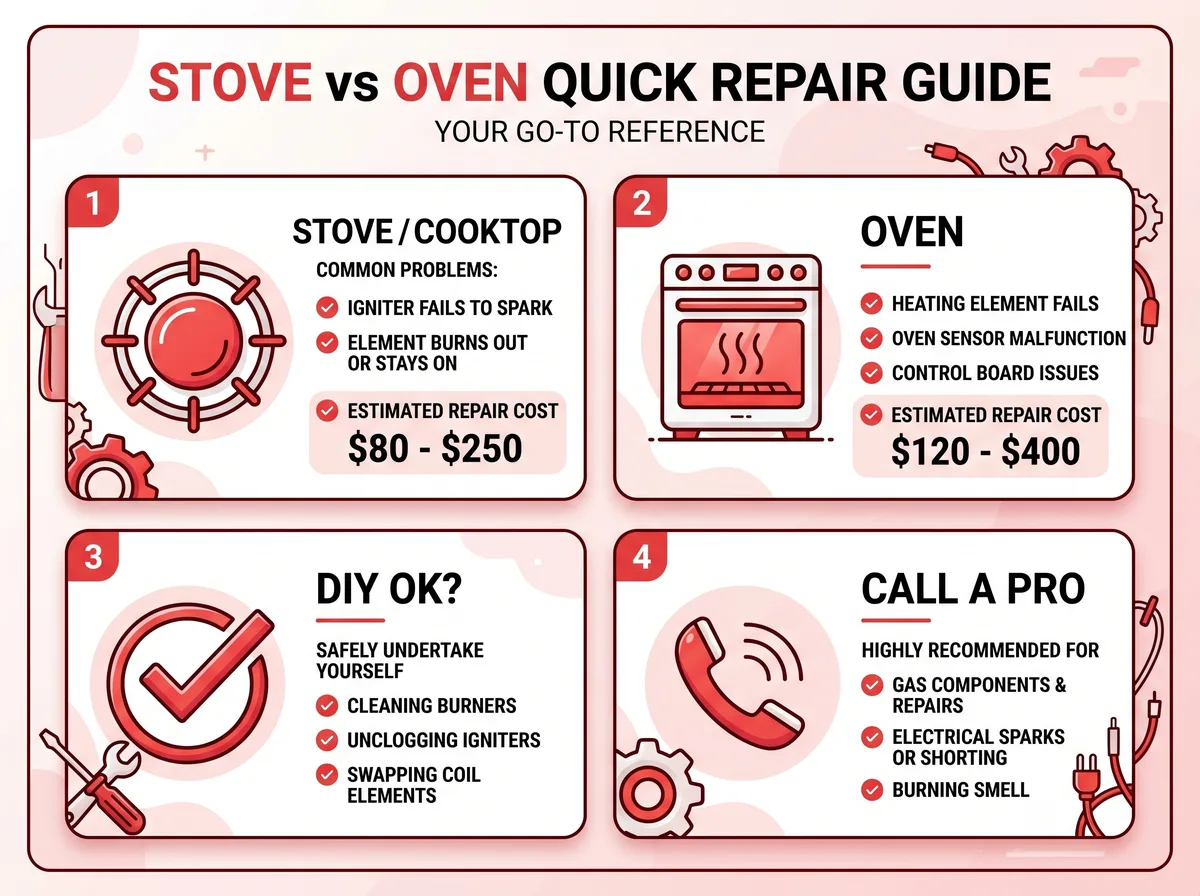
| Common failure | Igniter, element, switch | Element, sensor, control board |
| DIY-friendly? | Burner cleaning: yes. Gas components: no | Element swap: sometimes. Gas igniter: no |
| Repair cost range | $80 to $250 typical | $120 to $400 typical |
| TSSA required? | Yes, if gas components involved | Yes, if gas components involved |
Common stove and cooktop problems
Burners take more daily abuse than any other part of a kitchen range. Here’s what usually fails:
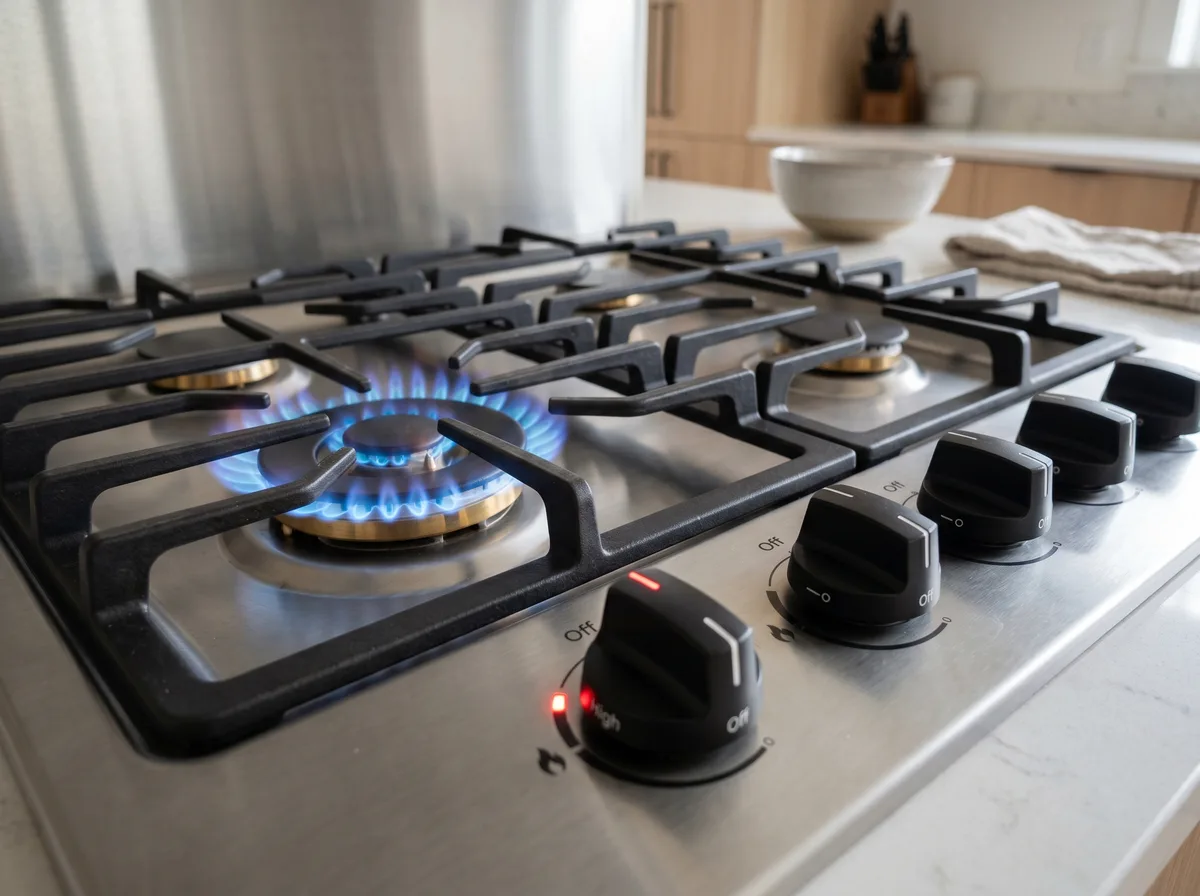
Gas burner won’t ignite
If the burner clicks repeatedly but won’t light, a clogged igniter port is the most likely cause. Food debris blocks gas from reaching the spark. Clean the burner port and cap with a dry toothpick, reinstall, and test. If the clicking stops after cleaning but the burner still won’t light, the igniter electrode may be cracked. Igniters typically run $30 to $70 for parts, plus labor, at a London repair shop.
One thing to watch for: if the burner lights but the igniter keeps clicking long after the flame is on, that’s a wet or dirty spark module, not a broken one. Dry it out completely before assuming the worst.
Electric burner not heating
On coil electric ranges, a burner that glows orange but doesn’t actually get hot has a dead spot in the element. Test it yourself: unplug the burner, swap it with a same-size working burner. If the problem moves with the element, replace the element (usually $15 to $35). If it stays in the same receptacle, the infinite switch (the component behind the knob) is the problem, which costs $40 to $90 to replace.
Induction cooktop not responding
Before calling anyone, confirm the pot is induction-compatible. Hold a magnet to the bottom of the cookware. If the magnet sticks firmly, the pan works on induction. If the cooktop still won’t respond to compatible cookware, error codes on the display usually point to the sensor or control board. Induction repairs are more specialized than coil or gas; look for a tech who has worked on the specific brand.
Common oven problems in London homes
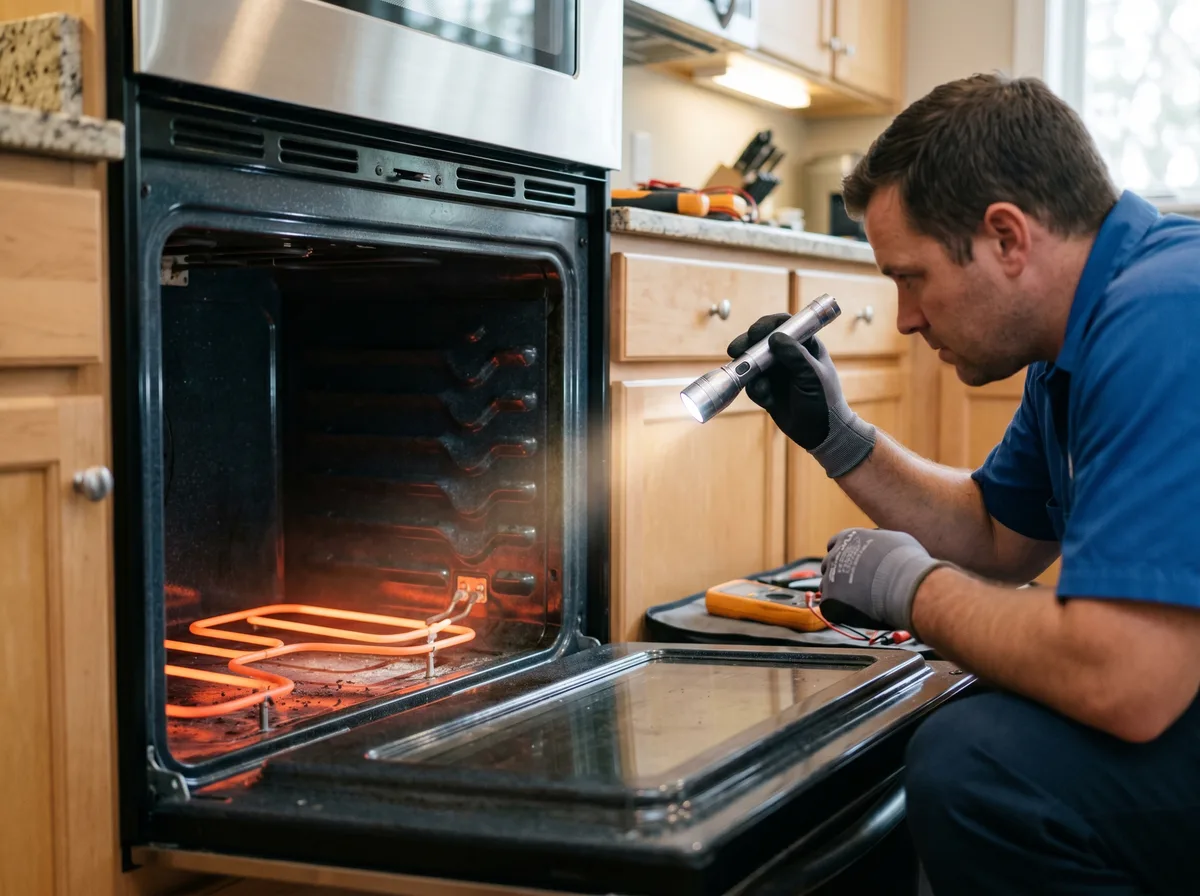
Oven not heating at all (electric)
On electric ovens, this almost always means the bake element burned out. Look inside the oven before calling anyone: a visible break or blister in the curved element at the bottom (bake) or top (broil) confirms it. Replacing a bake element is one of the more straightforward oven repairs. Parts for common brands (Whirlpool, GE, LG) are available locally and run $40 to $80. With labor, expect $120 to $180 total. If the elements look intact, the control board or thermal fuse is next on the list, and those are more expensive.
Oven running hotter or cooler than set
A $12 oven thermometer from any hardware store will confirm the problem. Set the oven to 350F and wait 20 minutes. If the thermometer reads 25 to 50 degrees off consistently, the temperature probe (also called the oven sensor or thermostat probe) is likely faulty. Probe replacement is a low-cost repair, typically $80 to $160 all-in. If the oven swings wildly between too hot and too cold rather than being consistently offset, that points to a relay or control board failure, which costs more.
Gas oven won’t ignite
The igniter on a gas oven glows to ignite the gas. It should glow bright orange within 90 seconds. A weak igniter that glows dull red but never quite lights the gas is one of the most common gas oven failures. This is a job for a licensed tech under TSSA regulations in Ontario. Gas appliance repairs involving fuel-carrying components must be done by a licensed gas technician. The igniter itself is inexpensive ($30 to $60), but it requires disconnecting the gas supply and following proper procedures.
Repair or replace? How to decide
The 50% rule is the most useful benchmark in the appliance repair business: if the repair costs more than half of what a comparable new unit would cost, replacement usually makes more sense. A new freestanding gas range in Canada runs $800 to $1,400 for a mid-tier model. A $200 control board repair on that same range is easy math. A $500 repair on an appliance worth $600 new is harder to justify.
Age matters more than people think. A 3-year-old Bosch or Samsung range is worth almost any repair that keeps it running. A 14-year-old unit with its third failure in two years is a different story. Parts availability also narrows as appliances age: once a manufacturer discontinues a control board, the cost to source one goes up, or it becomes impossible to source at all.
When to call a repair tech in London
Some stove and oven problems are safe DIY territory. Cleaning burner ports, swapping coil elements, checking the door gasket: these are reasonable home fixes. Call a London oven repair specialist when:
- Any gas line, valve, or gas component is involved. TSSA requires a licensed gas tech.
- You suspect the control board. Misdiagnosis wastes $200 to $400 in parts.
- The self-clean cycle ran and the oven stopped working afterward. Control board failure is the most common outcome of self-clean thermal stress.
- The oven temperature swings wildly rather than being consistently offset. That’s a relay or board issue, not just a bad probe.
- Any sparking, arcing, or burning smell. Treat every electrical smell as a fire risk until a tech confirms otherwise.
Appliance repairs across London and the surrounding area
Max Appliance Repair London serves homeowners across the region: London, Woodstock, St. Thomas, Ingersoll, Strathroy, and Tillsonburg. Most stove and oven repairs are completed same-day or next-day. If you’re not sure whether your issue is a stove problem or an oven problem, a quick call with a description of what’s happening is usually enough to narrow it down before a technician arrives.
Sources and references
- Natural Resources Canada – Home appliance energy ratings
- Consumer Reports – Kitchen range reliability ratings 2024
Disclaimer
This article is for general guidance only. Costs, products, regulations, and best practices change. Always confirm with a licensed professional for your specific situation, especially for any work involving gas appliances.
