
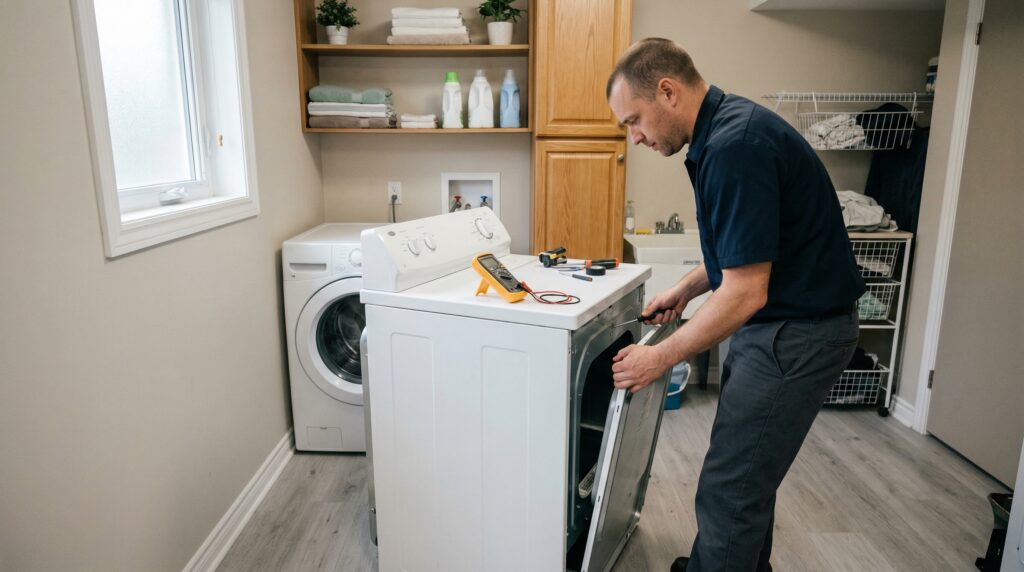
A dryer that runs the full 50 minute cycle and leaves your clothes damp is one of the most frustrating appliance failures, and it is one of the most common service calls we get across London Ontario, from Westmount to Stoney Creek. The fix is almost never the part most homeowners assume. After 15 years of dryer repair service calls in London and Middlesex County, the real causes follow a predictable order, and a working tech checks them in that order on every visit. Here is the same diagnostic sequence we use, what each problem actually looks like, and what the repair costs in 2026 London pricing.
Before anything: gas or electric?
The diagnostic split is huge. A gas dryer has an igniter, a flame sensor, a gas valve, and burner assembly that an electric dryer does not. An electric dryer has a heating element and high-limit thermostat that a gas dryer does not. About 60 percent of London homes have electric dryers (240V, 30 amp) and 40 percent have gas. Look at the back of your dryer: a thick black power cord with a four-prong plug means electric, a thin power cord plus a yellow flex line means gas. Make sure your tech is comfortable with both. Gas work requires Technical Standards and Safety Authority G2 certification in Ontario.
The six real causes of a dryer not heating in London ON
1. Clogged vent line (the silent killer)
This is the cause in roughly 35 percent of “no heat” calls we take in London. Lint builds up inside the 4 inch vent duct that runs from the back of the dryer to the outside wall. Once the vent is more than 70 percent blocked, the dryer overheats on every cycle, the high-limit thermostat trips out as a safety, and the heater shuts off. The drum keeps tumbling so the dryer looks like it is working, but no heat reaches your clothes. The terrifying part: a clogged vent is also the leading cause of dryer fires in Canada. Fix: clean the full vent line from the dryer back to the outside hood. Total bill $120 to $220 depending on access. We do this on every “no heat” visit before touching parts because it is often the only fix needed.
2. Heating element burned out (electric dryers)
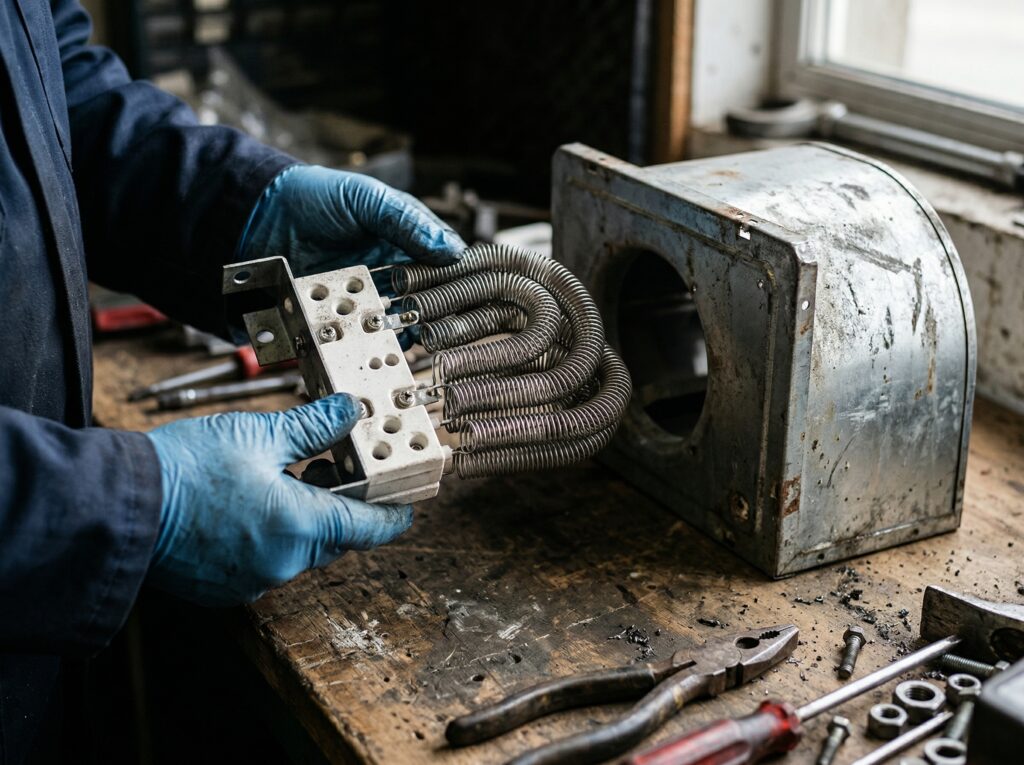
The heating element is a coiled nichrome wire wrapped around a ceramic frame inside a metal housing. When it burns through, the dryer runs cold. You can test it with a multimeter: a healthy element reads 8 to 30 ohms across the terminals. An open element reads infinity. Fix: replace the element. Parts $60 to $180 depending on brand. Labour 60 to 90 minutes. Total bill $260 to $440.
3. Igniter failure (gas dryers)
The igniter is a glass-encased silicon carbide rod that glows red hot to ignite the gas. They are fragile and they fail roughly every 5 to 8 years. When the igniter is dead, the dryer cycles, the gas valve waits for the flame sensor signal, no flame happens, and the cycle finishes cold. Fix: replace the igniter. Parts $40 to $80. Labour 45 to 75 minutes. Total bill $230 to $360.
4. Tripped thermal fuse
The thermal fuse is a one-shot safety device that blows when the dryer overheats and stays blown until you replace it. It almost always blows because of cause number 1, the clogged vent. Replacing the fuse without cleaning the vent means the new fuse blows on the next load. Fix: clean the vent first, then replace the thermal fuse. Parts $8 to $20. Total bill (combined with vent clean) $180 to $280.
5. Failed high-limit thermostat or cycling thermostat
The high-limit thermostat opens at around 250 F as an overheat safety. Some models reset themselves, others stay open until replaced. The cycling thermostat regulates normal operating temperature. Either one can fail open and kill the heat. Fix: identify which thermostat with a multimeter, replace the failed one. Parts $20 to $60. Total bill $220 to $320.
6. Failed gas valve coils (gas dryers only)
The gas valve has two solenoid coils that open the valve in stages on each ignition cycle. When one coil weakens, the valve does not open fully and the burner cycles erratically or not at all. You will see the igniter glow but no flame, or a brief flame followed by an immediate shutoff. Fix: replace the coil pair. Parts $50 to $90. Labour 60 minutes. Total bill $260 to $380.
The diagnostic order a real London tech follows
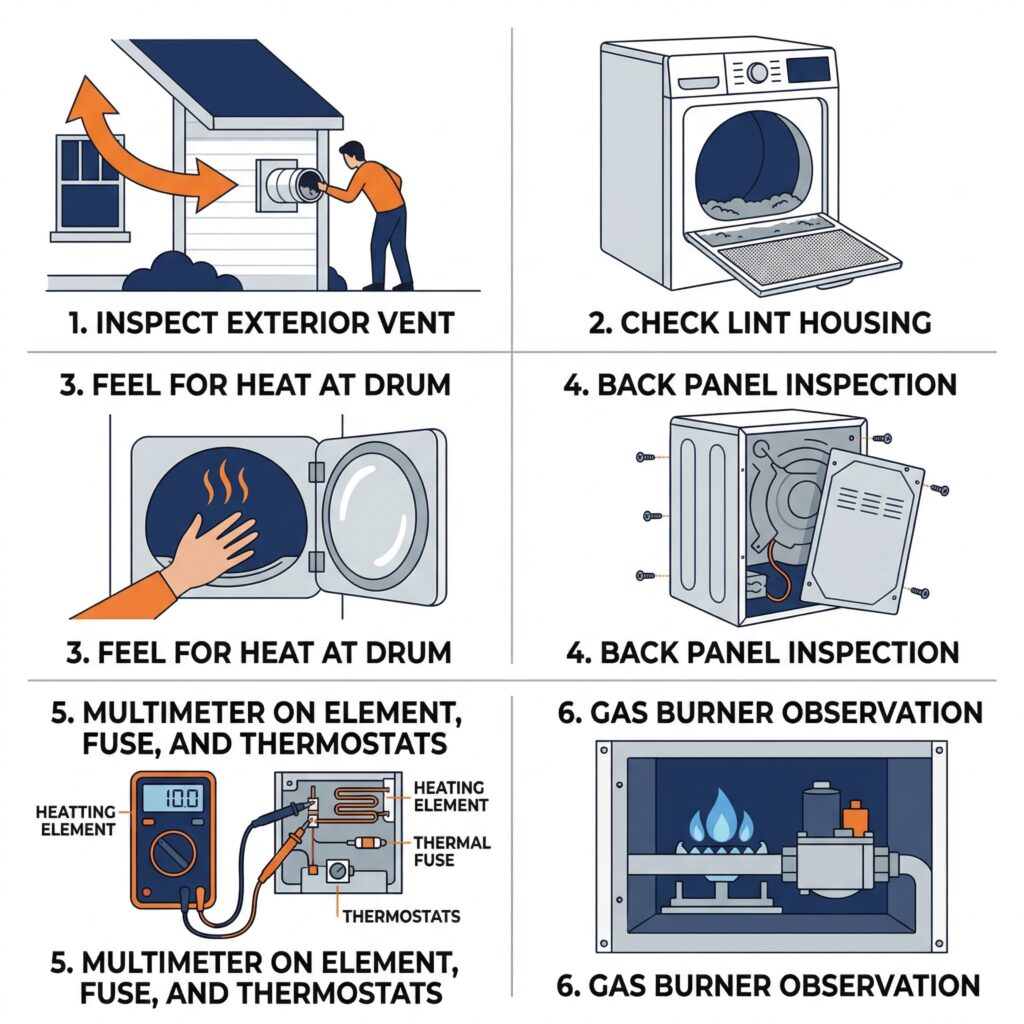
- Inspect the vent. Disconnect the duct at the back of the dryer and check airflow with the dryer running on high heat. Weak airflow at the outside hood means clogged vent.
- Check the lint trap and lint trap housing. Most homeowners clean the screen but never the housing below it. Lint accumulation here mimics a clogged vent.
- Run the cycle and feel for heat at the drum entrance. No heat at all means element, igniter, thermal fuse, or thermostat. Weak heat that fades means vent or cycling thermostat.
- Pull the back panel and visually inspect for burned components, smell of overheated insulation, or discoloured wiring. Test the heating element or igniter with a multimeter for continuity.
- Test the thermal fuse and thermostats with a multimeter. Replace any that read open.
- On gas units, observe ignition through the burner viewport (most gas dryers have one). If igniter glows but no flame, gas valve coils. If no glow, igniter or thermal fuse on the burner side.
This sequence catches the cause in about 95 percent of London ON service calls within 30 minutes.
What homeowners can safely check before calling
- Clean the lint screen completely. Hold it up to a light. If you cannot see through it clearly, fabric softener residue is blocking airflow. Wash it with warm soapy water and a soft brush.
- Walk outside and check the vent hood while the dryer is running. You should feel strong warm airflow and the flap should be wide open. Weak or no airflow means clogged vent line.
- Check the breaker on electric dryers. A 30 amp double pole breaker. If only one half tripped, the drum will turn but the heater will not get 240 volts.
- Make sure the gas valve to the dryer is fully open on gas units. Yellow handle parallel to the pipe means open.
- Try a smaller load. A jammed full load can also reduce drying performance and mimic a heat problem.
If the lint screen is clean, the vent hood blows strong air, the breaker is on, and the dryer still runs cold, it is time to call a tech.
What the repair costs in London ON in 2026
- Diagnostic fee (waived with repair): $89 to $110
- Vent line clean and inspection: $120 to $220
- Heating element replacement (electric): $260 to $440
- Igniter replacement (gas): $230 to $360
- Thermal fuse plus vent clean: $180 to $280
- High-limit or cycling thermostat: $220 to $320
- Gas valve coils: $260 to $380
- Full burner assembly rebuild (rare): $420 to $640
Why DIY parts swaps usually backfire
The classic London homeowner story: orders a $50 heating element on Amazon, swaps it in, runs a load, the dryer heats for one cycle, then dies. The cause was a clogged vent. The new element overheated on the first run and the high-limit thermostat is now open. Two parts ordered, two hours of work, no fix. Pay a tech to diagnose the root cause first, then choose to do the part swap yourself if you want, with confidence that it is the right part.
When to replace the dryer instead of repairing
A dryer under eight years old is almost always worth repairing unless the drum bearing has failed (a rare but expensive job). Between eight and twelve years old, repair if the bill is under 40 percent of replacement and the motor is healthy. Past twelve years on a builder grade unit, replacement starts to make sense, especially if you can move to a heat pump dryer that cuts your hydro use roughly in half. Premium brands like Miele and Speed Queen are worth repairing past 18 years.
Frequently asked questions
Why does my dryer take three cycles to dry one load?
That is the textbook symptom of a partially clogged vent line. The dryer is producing heat but cannot exhaust it, so the cycle ends with damp clothes. Clean the vent and the dryer time drops back to 35 to 50 minutes per load. If vent cleaning does not fix it, the next suspect is the heating element running at reduced power.
Is a clogged dryer vent really a fire risk?
Yes. The Office of the Fire Marshal of Ontario lists clogged dryer vents as one of the top three causes of residential laundry fires. The lint inside an overheating duct can ignite at temperatures the dryer reaches in normal operation when airflow is restricted. Annual vent cleaning is the cheapest fire prevention you can buy.
How do I know if my dryer is gas or electric?
Look at the back. A thick black power cord with a four-prong (or three-prong on older homes) 240V plug and no gas line means electric. A thin standard power cord plus a yellow corrugated flex gas line means gas. If you are not sure, the model number on the data plate inside the door will start with different prefixes for the two versions.
Can I clean the vent line myself?
The first three feet from the dryer, yes, with a vacuum and a brush. The full run from the back of the dryer to the outside hood, especially on long basement runs in older London bungalows, is a job for a tech with proper rotating brush equipment. A botched DIY clean can leave compacted lint deeper in the duct.
How fast can Max Appliance Repair London come out for a dryer?
Same week, often next day. Dryer no-heat calls jump in spring and fall when the laundry load goes up. We carry every common heating element, igniter, thermal fuse, and thermostat on the truck, so most repairs are completed in one visit.
Get the right diagnosis on your London Ontario dryer
A dryer that runs cold is almost never a major repair. Six out of seven London ON service calls finish in one visit for under $400. The expensive jobs come from skipping the diagnostic step or replacing parts that were not actually broken. book a service call in London, ON and we will run the full sequence on your specific dryer and tell you exactly what is wrong before any parts get ordered.
