

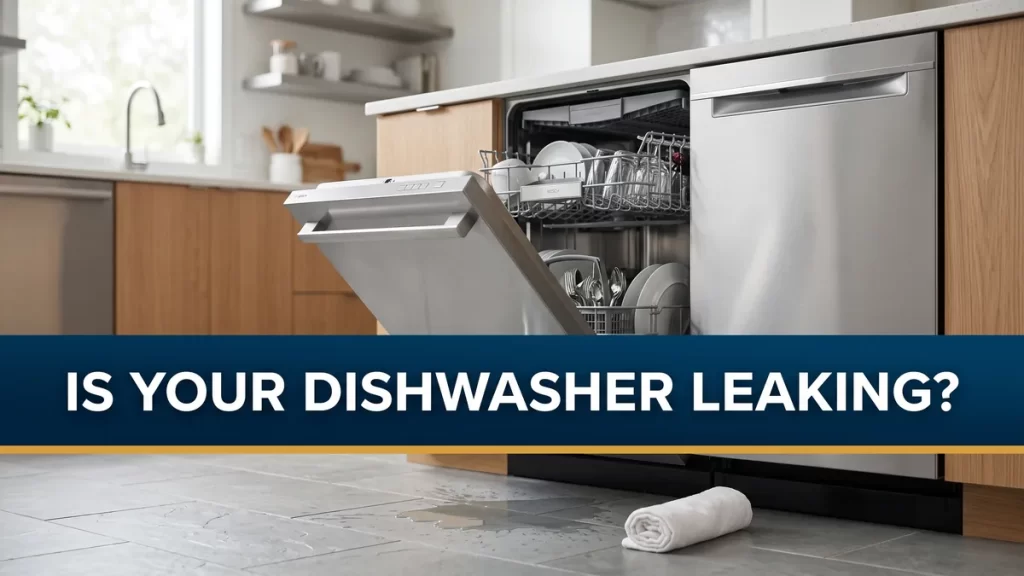
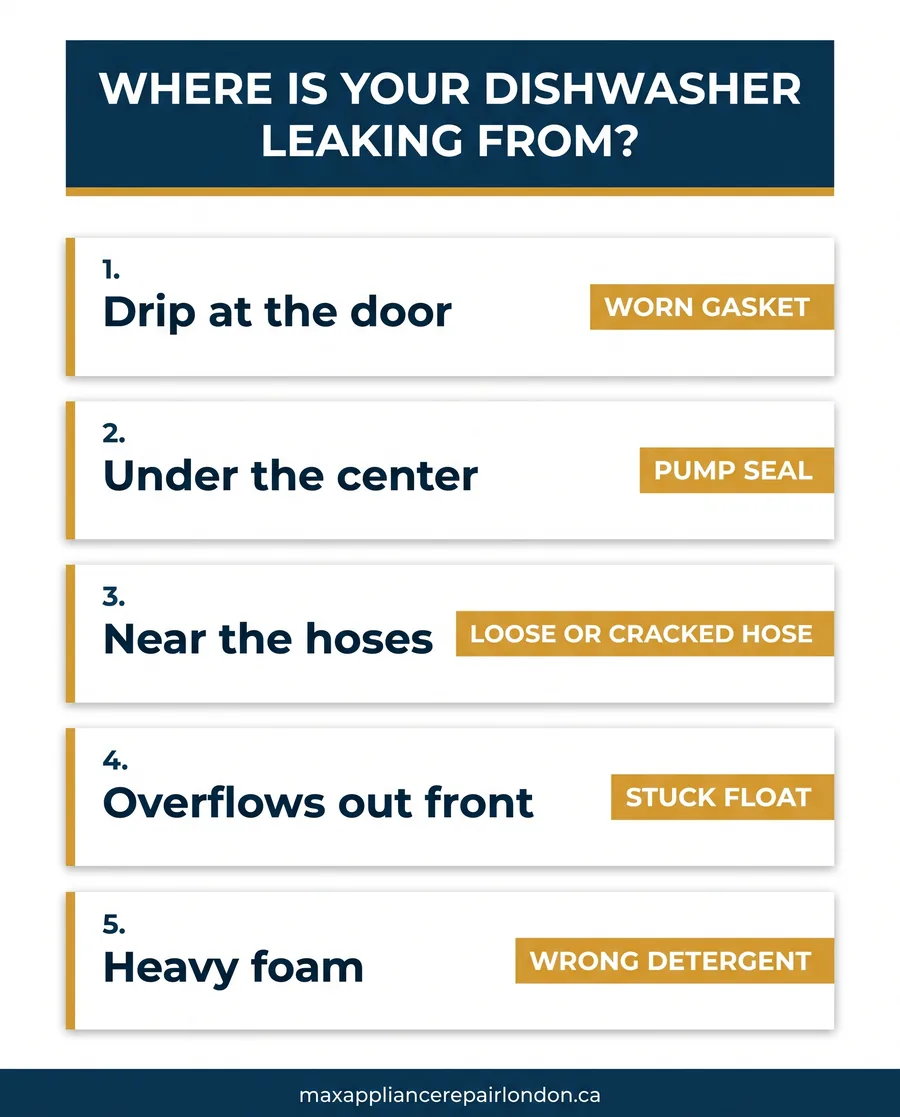
A dishwasher leaking from bottom edges usually traces to one of five parts: the door gasket, the pump seal, a cracked hose, a stuck float, or the wrong detergent. Most St. Thomas homeowners can find the culprit in about ten minutes with a flashlight and a towel. If the water keeps coming or you spot it pooling under the tub, a quick dishwasher repair in St. Thomas beats letting it warp your kitchen floor.
Water on the floor is rarely random. It leaves clues about where it came from, and those clues point straight to the fix. Here is how to read them before the puddle spreads under the cabinets.
First move: stop the water and look
Pull the bottom rack, lift out the lower spray arm if it comes free, and shine a light around the base of the tub. Dry everything with a towel, run a short rinse cycle, and watch. Where the first bead of water appears tells you almost everything. A drip at the door means one thing. A puddle that creeps out from dead center under the machine means something else entirely.
Quick take
Front of the door means a gasket or latch problem. Straight down the middle means a pump seal or hose. Only during the wash, not the fill, points to a cracked hose under pressure. Note the timing and the spot before you reach for a wrench.
The door gasket and door leaks
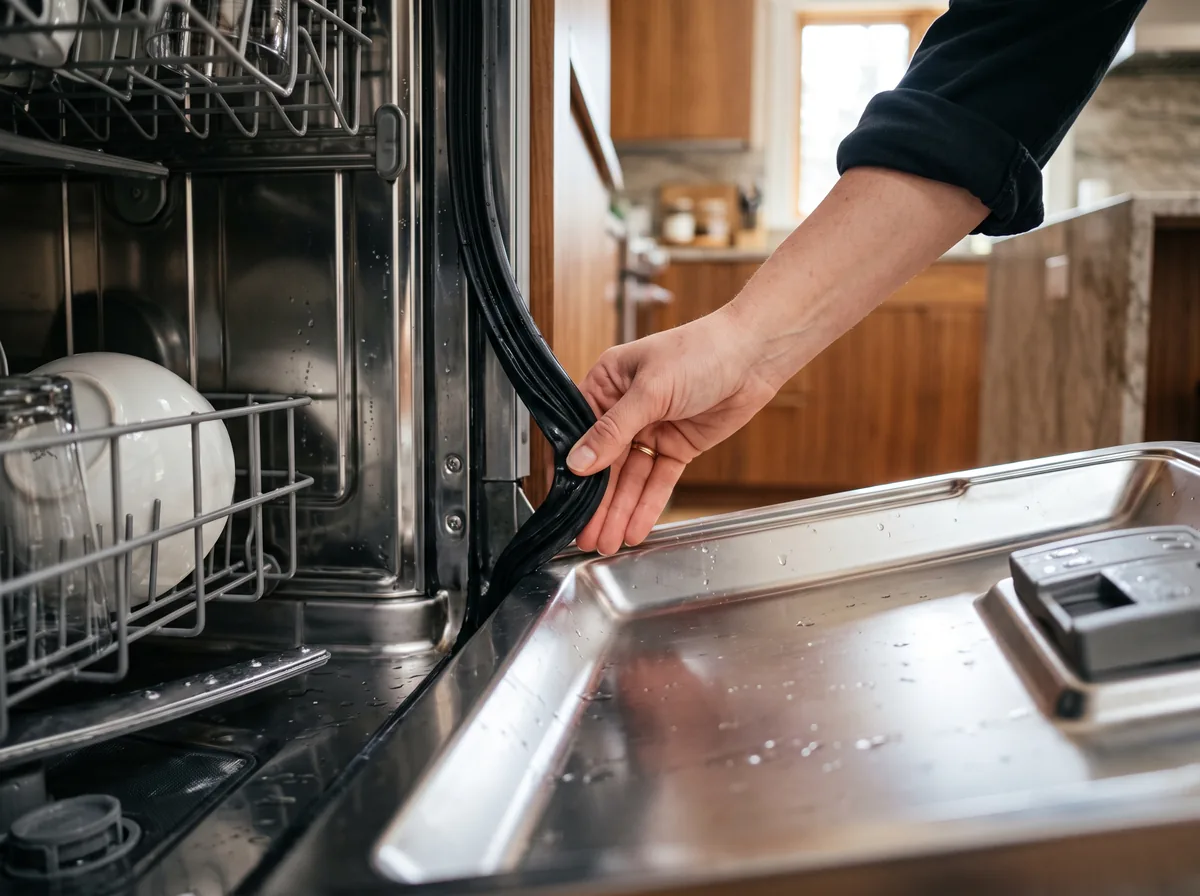
The most common reason for a dishwasher leaking from bottom door corners is a tired gasket. That rubber or vinyl seal runs around the door opening, and it is the only thing keeping wash water inside when the door is shut. Over a few years it hardens, flattens, or picks up a crust of old detergent and grease that stops it sealing flush.
Run a finger along the whole gasket. You are feeling for cracks, sticky spots, or a section that has pulled loose from its channel. Wipe it down with warm soapy water and check again. If a leak shows up in the same corner every cycle, the seal there has failed and needs replacing. Also check the door latch: if the door does not pull fully closed, even a perfect gasket cannot hold the water back.
Pro tip
Old, dried food and hard water scale are gasket killers. Wipe the seal and the door edge every couple of weeks and run a monthly cleaning cycle with a dishwasher cleaner. A supple, clean gasket is the cheapest leak prevention there is, and it costs you nothing but two minutes.
A worn pump seal under the tub
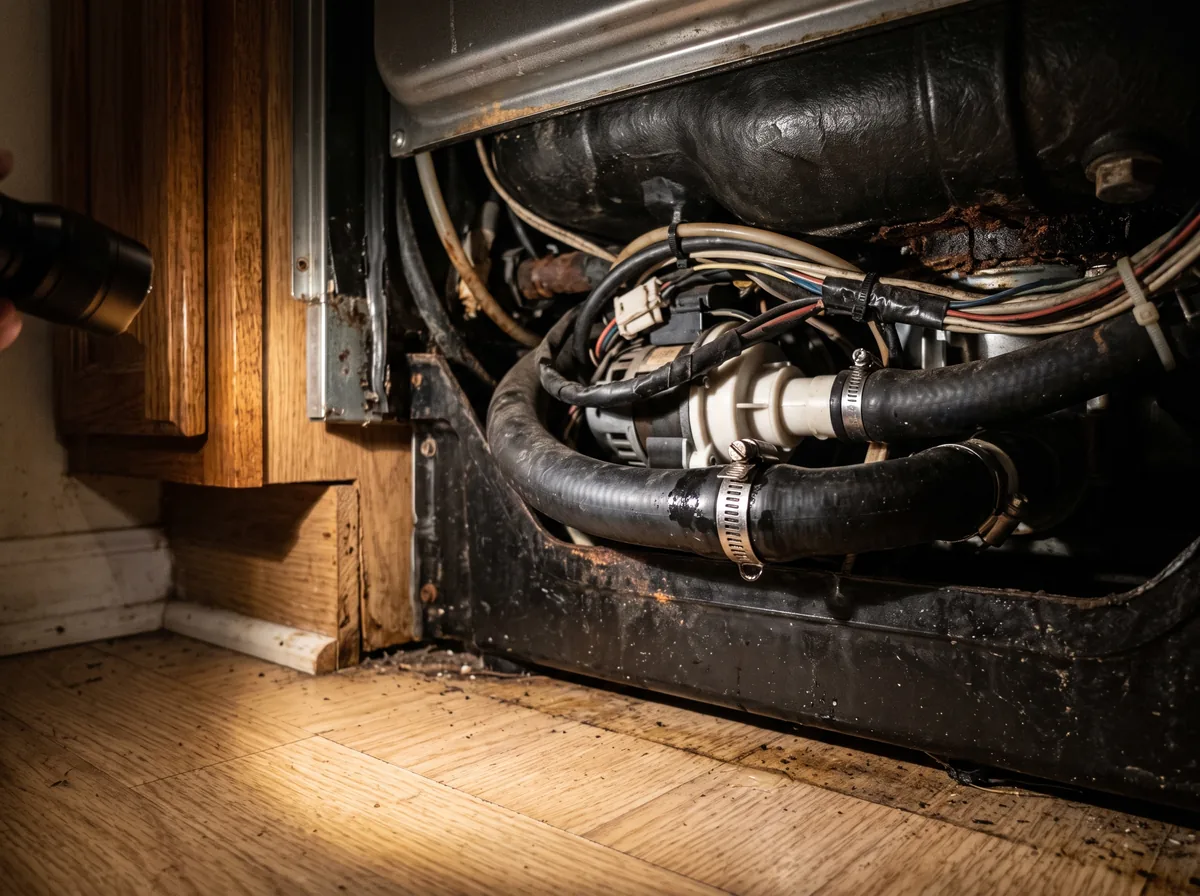
If the water shows up under the middle of the machine rather than at the door, suspect the pump. The circulation and drain pumps sit below the tub, and each relies on a seal to keep water from escaping around the motor shaft. Years of hot, soapy water wear that seal down until it weeps, usually only while the pump is running. This area sits close to the motor wiring, so it is where most homeowners hand the job over. A technician can tell a leaking pump seal from a cracked housing quickly and replace only the part that failed, rather than guessing and buying parts you never needed.
People often ask: why does my dishwasher only leak during the wash cycle?
A leak that appears only when the machine is washing, not while it fills or sits idle, almost always means a part that holds pressure has failed. That is usually the pump seal, a cracked circulation hose, or the spray arm mounting. Water escapes only when the pump pushes it hard. Watch which minute of the cycle the puddle appears and you narrow it down fast.
Cracked or loose hoses and clamps
Hoses are the quiet culprit. Your dishwasher has a fill hose, a drain hose, and internal hoses that feed the spray arms, all held on with clamps. Vibration, age, and the constant heat and cool cycle loosen those clamps and crack the hose walls. A pinhole you cannot even see can push a surprising amount of water onto the floor over a full cycle.
- Check the fill and drain hose connections under the sink first. They are easy to reach and a loose clamp is a two-minute fix.
- Look where the drain hose loops up to the air gap or high under the counter. A cracked loop drips slowly and often goes unnoticed.
- Feel along each hose for damp spots or mineral crust, the telltale ring left behind when water dries and evaporates.
- Watch the clamps. A clamp that has slipped or rusted lets the hose weep right at the joint.
Tighten a loose clamp and you may be done. A split hose needs replacing, and matching the right part for your make and model is where a fridge and appliance repair service saves you a second trip to the parts counter.
A stuck float and the wrong detergent
Two overlooked causes cost nothing to rule out. The first is the float switch, a small plastic dome on the tub floor that tells the dishwasher when it has enough water. If food debris jams it in the down position, the machine keeps filling and overflows out the bottom. Lift it gently and make sure it moves freely.
The second is suds. Regular hand dish soap, or too much of any detergent, produces a mountain of foam that pushes past seals that would otherwise hold. If your leak started right after you grabbed the sink soap, that is almost certainly your answer. Only use detergent made for dishwashers, and go easy on the amount.
Diagnosing a dishwasher leaking from bottom
Match where and when you see water to the likely cause. Use this as a starting point, then confirm with a close look at the part itself.
| Where the water shows up | When it happens | Most likely cause |
|---|---|---|
| Front, at the door | Every cycle | Worn door gasket or a latch that will not close fully |
| Straight down the center | Only while washing | Pump seal or a cracked circulation hose under pressure |
| Under the sink area | During fill or drain | Loose hose clamp or a split fill or drain hose |
| Front, as an overflow | Machine keeps filling | Float switch jammed with debris |
| Front, with heavy foam | Started after a soap change | Wrong detergent or too much of it |
Download the free quick guide
A one-page checklist to trace a dishwasher leak by where and when the water appears, and fix it safely.
When to call a St. Thomas technician
Call for service when the leak comes from under the middle of the machine, when it returns after you replaced the obvious part, when you smell burning or the pump sounds rough, or when water has already reached your flooring. Those are not two-minute fixes, and a wrong guess on the pump gets expensive. A technician tests the actual failure point and swaps only the part that gave out, so you are not paying for parts your dishwasher never needed.
Frequently Asked Questions
Still tracing a leak you cannot pin down? Max Appliance Repair London handles dishwasher faults across St. Thomas, London, and Ingersoll. Book a dishwasher diagnosis and we will find the source, dry it up for good, and keep the water out of your floor.
