
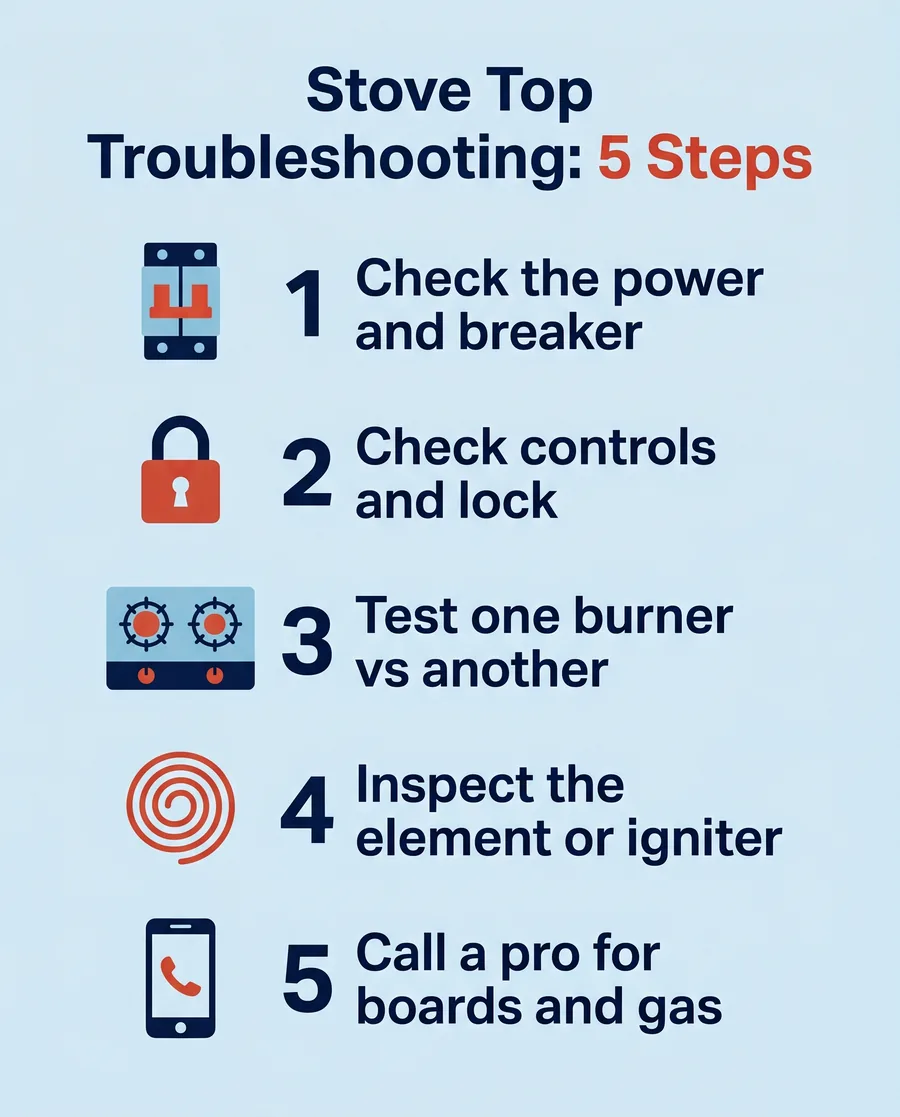
Why is your stove top not working? Nine times out of ten it is one of five things: no power to the appliance, a failed element or igniter, a faulty surface switch, a control-lock setting, or a problem on the control board. The good news is that you can rule out most of these in about ten minutes with no tools and no risk. This 2026 checklist walks through them in the order a technician would, from the simple and free to the jobs that need a pro. If you would rather hand it off, our stove repair team in London handles gas and electric cooktops every day.
Work through the steps in order and stop the moment one of them solves the problem. A quick warning up front: cooktops mix electricity, heat, and on many homes gas, so safety comes before everything else.
In this article
- Before you start: safety first
- Step 1: confirm the stove has power
- Step 2: check the controls and lock setting
- Step 3: test one burner against another
- Electric cooktops: elements and switches
- Gas cooktops: igniters and burner ports
- When to call a technician
- What stove top repairs cost in London
- Frequently asked questions
Before you start: safety first
Safety first: The tips here are for general guidance only. Max Appliance Repair London is not responsible for any damage, injury, or cost resulting from action taken based on this content. Always unplug an appliance at the wall before you inspect it. Do not attempt electrical repairs unless you are qualified, and never work on a gas appliance yourself. In Ontario, gas work must be carried out by a TSSA-licensed technician. When in doubt, stop and call a professional.
Two rules before you touch anything. First, for any check that involves looking inside the appliance, switch the stove off and unplug it, or shut off its breaker. Second, and this one is not optional: if you have a gas cooktop and you smell gas, do not flip switches, do not light anything, leave the home, and call your gas utility or 911 from outside. In Ontario, gas appliance repairs must be carried out by a TSSA-licensed technician, so the gas section below is about safe diagnosis only, not repair.

Step 1: confirm the stove has power
It sounds obvious, but a dead cooktop is often a power problem, not a broken stove. Electric ranges draw a lot of current and run on a dedicated breaker, which can trip without taking the rest of the kitchen with it.
- Check the breaker. Find the breaker labelled for the range or kitchen and flip it fully off, then on. A tripped breaker is the single most common cause of a totally dead cooktop.
- Check the plug. Slide-in and freestanding ranges plug into a dedicated outlet. Confirm the cord is seated. If it was recently moved for cleaning, it may have worked loose.
- Check the clock and display. If the oven clock is dark too, you have lost power to the whole appliance. If the clock works but the burners do not, power is fine and the fault is further in.
Did you know: a dark display narrows it down fast
The control display is a free diagnostic tool. If the whole panel is dead, the problem is power: a breaker, the outlet, or the cord. If the display lights up normally but a burner will not heat, power is reaching the stove and the fault lies in a switch, an element, or the control board. That one observation tells a technician half of what they need to know before they arrive.
Step 2: check the controls and lock setting
Modern cooktops are full of features that can look exactly like a fault. Before you assume a part has failed, rule out the settings, because this fix costs nothing and embarrasses a surprising number of service calls.
- Control lock or child lock. Many cooktops have a lock that disables the surface. Check the manual for the unlock sequence, often holding a lock button for a few seconds.
- Touch controls and moisture. On glass touch panels, spilled liquid or a wet cloth on the controls can block them. Wipe the surface completely dry and try again.
- Demo or showroom mode. A stove that displays normally but never heats may be stuck in a demo mode from the factory or store. The manual lists how to exit it.
- An error code on the display. A code is the appliance naming its own problem. Note it down. Our guide to common appliance error codes helps you decode it.
Step 3: test one burner against another
If the whole cooktop is dead, the cause is usually power or the control board. If only one burner is out, the problem is almost always local to that burner. The fastest way to tell them apart is a swap test.
On a traditional electric coil stove, you can often pull the dead coil element out of its socket and plug a working element from another burner into it. If that burner now heats, the element you removed is the culprit and a new one is a cheap, easy fix. If the same burner stays dead with a known-good element, the fault is in the socket or the surface switch behind it.
Save money: swap the element before you buy anything
A replacement coil element is one of the most affordable appliance parts there is, but you only want to buy one if it is actually the problem. The swap test costs nothing and answers the question in two minutes. If a borrowed element heats in the dead spot, order the part with confidence. If it does not, you have just saved yourself from buying a part you did not need.
People often ask: my glass cooktop is dead but the oven works, why?
On many ranges the cooktop and the oven share one control board but run on separate circuits and switches inside the appliance. So a working oven with a dead cooktop usually means the appliance has power and the problem sits in the cooktop wiring, the surface switches, or the part of the control board that drives the burners. It points the diagnosis squarely at the cooktop rather than a whole-appliance failure, which is often better news for the repair bill.
Electric cooktops: elements and switches
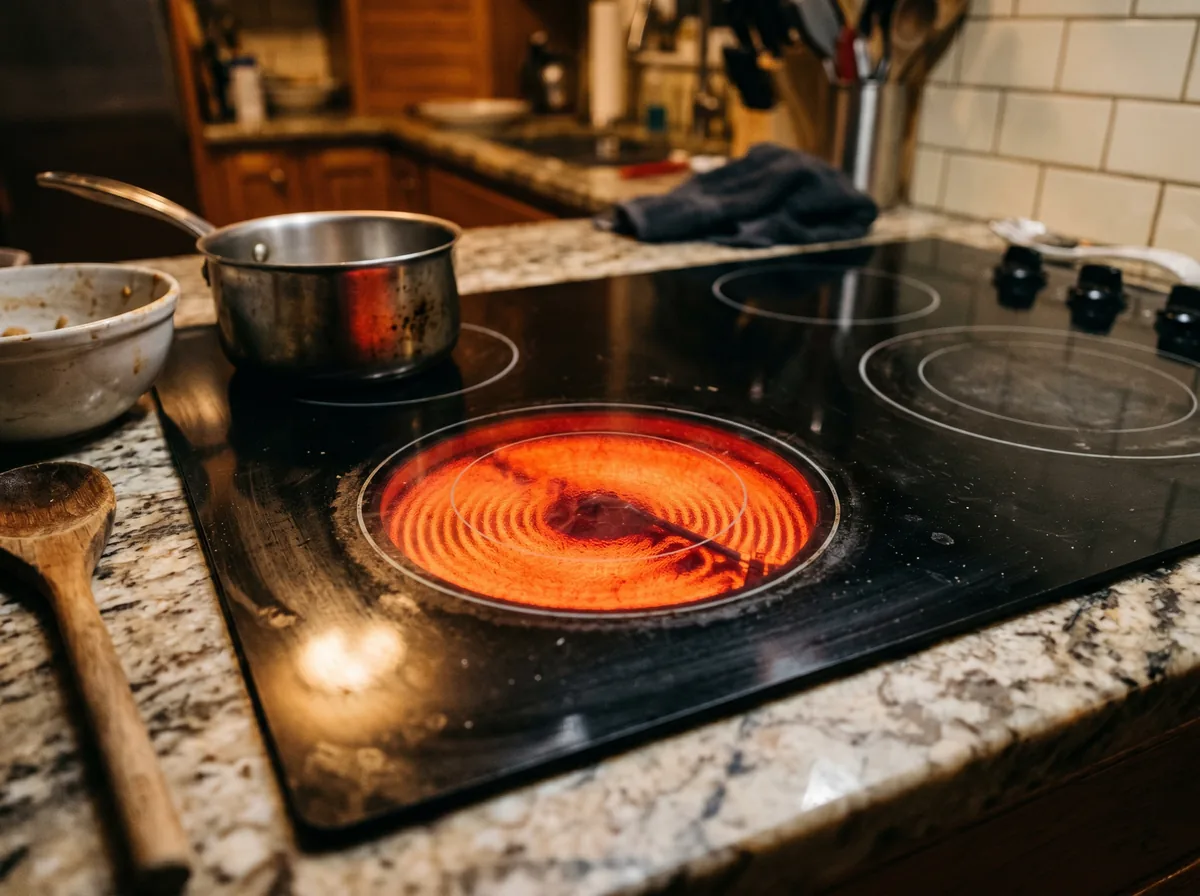
On electric cooktops, a single dead burner usually comes down to the element, the socket it plugs into, or the infinite switch (the knob assembly that controls the heat). Coil elements and their sockets are the easiest and cheapest to deal with. Glass-top radiant elements sit under the surface and are a technician job, since getting to them means opening the cooktop.
If every burner is dead but the display works, suspect the surface element control board or a wiring fault. That is a repair to leave to a professional, and on an older range it is worth weighing against replacement. Our piece on repairing versus replacing an appliance can help you decide.
Gas cooktops: igniters and burner ports
On a gas cooktop, a burner that clicks but will not light, or lights unevenly, is usually one of two simple things you can safely address yourself: a dirty burner or a wet igniter. After the cooktop is fully cool, lift off the burner cap and grate and clean the burner ports with a stiff brush or a straightened paper clip, since food and grease block the gas holes. Make sure the cap is seated correctly and bone dry, because moisture stops the spark.
Red flag: anything beyond cleaning is a licensed job
Cleaning the burner and seating the cap is the limit of safe do-it-yourself work on a gas cooktop. If the igniter still will not spark, the gas valve is suspect, or you smell gas at any point, stop. In Ontario, gas appliance repairs must be done by a TSSA-licensed technician. Do not remove gas lines or internal parts yourself. If you smell gas, leave the home and call your utility or 911 from outside.
When to call a technician
You have done your part once the free checks are exhausted. Call a professional when:
- The whole cooktop is dead, the breaker is fine, and the display either works or does not.
- A swap test shows the socket or surface switch has failed rather than the element.
- A glass radiant element needs replacing, which means opening the cooktop.
- You see scorched wiring, smell burning, or the controls behave erratically.
- Anything on a gas cooktop beyond cleaning the burner and seating the cap.
A cooktop and an oven are not the same repair, and pricing differs. If your oven is also acting up, see our comparison of stove versus oven repairs in London.
What stove top repairs cost in London
Pricing note: The figures on this page reflect typical market rates in London, Ontario and the surrounding area as of 2026. What you actually pay depends on the make and age of your appliance, the parts involved, and how easy the unit is to access. Always get a written quote before approving a repair.
The figures below are typical starting points for London, Ontario in 2026, to help you set expectations before you book. For more detail, see our appliance repair cost guide.
| Likely cause | Typical repair range (2026) | Difficulty |
|---|---|---|
| Tripped breaker or loose plug | Often free to fix yourself | Easy |
| Control lock or wrong setting | Free, check the manual | Easy |
| Coil element replacement | $60 to $180 | Easy DIY or technician |
| Surface switch or socket | $150 to $350 | Technician |
| Glass radiant element | $200 to $450 | Technician |
| Surface control board | $300 to $600 | Technician |
| Gas igniter or valve | $200 to $450 | TSSA-licensed only |
Sources and further reading
- Max Appliance Repair London, in-house diagnostic experience and 2026 London, Ontario service pricing.
- Technical Standards and Safety Authority (TSSA), Ontario rules on who may perform gas appliance work.
- ApplianceChamps, “Fix an electric stove burner not working” (video, embedded above).
Frequently asked questions
Why is only one burner on my stove top not working?
A single dead burner almost always points to a local fault rather than a whole-stove failure. On a coil cooktop, the most common cause is the element itself, which you can confirm by swapping in a working element from another burner. If a known-good element still will not heat in that spot, the problem is the socket or the surface switch behind it. On a glass cooktop, a single dead burner usually means the radiant element or its switch, which is a technician repair since it requires opening the cooktop surface.
My whole cooktop is dead but the oven still works. What does that mean?
It usually means the appliance has power and the fault is specific to the cooktop. The oven and cooktop often share one control board but run on separate switches and circuits inside the range. A working oven rules out a total power loss and points the diagnosis at the cooktop wiring, the surface element control board, or the switches. That is generally easier and cheaper to address than a complete appliance failure, but the board and wiring work should be left to a qualified technician.
Is it safe to fix a gas stove top myself?
Only the basics. After the cooktop is fully cool, you can safely clean the burner ports and the igniter and reseat the burner cap, which solves many gas burners that click but will not light. Anything beyond that, such as the gas valve, the wiring, or the gas line, must be left to a professional. In Ontario, gas appliance repairs legally must be carried out by a TSSA-licensed technician. If you ever smell gas, do not touch any switches, leave the home, and call your gas utility or 911 from outside.
How do I know if it is the element or the switch?
The swap test is the clearest way to tell them apart on a coil cooktop. Pull the dead element and plug a working element from another burner into the same socket. If the burner now heats, the original element was the problem, and a replacement is inexpensive. If the burner stays cold with a known-good element, the fault is in the socket or the infinite switch that controls it, which is a technician repair. The test takes a couple of minutes and tells you exactly which part to deal with.
The checklist in a nutshell
A stove top that will not work is rarely the disaster it feels like at dinnertime. Run the checks in order and most of the time you will find the answer, often for free.
- Confirm power: reset the breaker, check the plug, watch the display.
- Rule out settings: control lock, moisture on touch panels, demo mode, error codes.
- Test one burner against another to find whether it is the element or the switch.
- Clean a gas burner, but leave all gas repairs to a TSSA-licensed technician.
- Call a professional for control boards, wiring, glass elements, and anything gas.
Download the free quick guide
Keep our printable five-step checklist in the kitchen drawer so you can work through a dead cooktop calmly the next time it happens.
Stove top still not working in London?
If the checklist points to a switch, a control board, a glass element, or anything on a gas cooktop, leave it to us. Book stove and cooktop repair in London with our local team, or contact us for service across London, St. Thomas, Woodstock, and the surrounding area. We repair gas and electric cooktops safely and fast.
